
Automotive Manufacturing (Motorcycle Assembly)
The Need: Ensuring Precision in a Safety-Critical Assembly Process
A leading motorcycle manufacturer sought to improve the accuracy and efficiency of its tyre rim assembly process—one of the most critical steps in motorcycle production. During assembly, bearings are manually placed before being clamped onto the tyre rim. Any incorrect bearing orientation at this stage can result in assembly defects, increased rework, production delays, and potential safety risks in the finished motorcycle.
This challenge was further compounded by real-world manufacturing conditions commonly found in automotive environments:
- Subtle orientation differences between the front and back of the bearing, making visual differentiation extremely difficult
- Steep-angle positioning of the bearing during assembly, limiting camera visibility and inspection consistency
- Black bearing surfaces, which absorb light and reduce contrast, leading to unreliable visual checks under variable lighting
Traditional manual inspection was time-consuming, inconsistent, and highly dependent on operator skill and experience. The manufacturer needed a high-precision, automated inspection solution capable of handling these complexities—while reducing operator workload and enabling fast, repeatable setup on the production line.
The Technology: Omron FHV7-AI AI-Lite Smart Camera

To overcome these challenges, the manufacturer deployed Omron’s FHV7-AI AI-Lite Smart Camera, fully integrated into the tyre rim assembly line and Omron’s automation ecosystem.
The FHV7-AI combines conventional rule-based vision with self-learning AI, enabling robust orientation inspection without the need for complex programming or specialized vision expertise. This hybrid approach makes it particularly well suited for automotive assembly applications where precision, and repeatability are essential.
Key capabilities include:
- Dual Orientation Detection: Simultaneously identifies two bearing orientations with high precision, ensuring correct placement before clamping
- AI-Powered Vision: Self-learning AI automatically selects optimal images and determines detection thresholds, eliminating manual tuning and enabling setup within minutes
- Quick Deployment & Iterative Verification: An intuitive interface supports rapid installation, iterative testing, and fine-tuning, accelerating commissioning and time to stable operation
- All-in-One Smart Camera Design: Integrated lens, lighting, and image processing simplify system design and reduce hardware complexity
- Adaptability to Harsh Conditions: Maintains stable detection performance despite black components, steep mounting angles, and fluctuating lighting conditions
- Enhanced Quality Assurance: Consistent and repeatable inspection minimizes the risk of orientation errors and costly downstream rework
By embedding AI processing, the FHV7-AI eliminated the need for external PCs and complex system architectures—simplifying deployment and maintenance.
The Outcome: Measurable Improvements in Quality and Efficiency
Following implementation, the manufacturer achieved significant gains across quality, productivity, and operational stability:
- Zero Orientation Errors: Eliminate manual checking errors, ensuring consistent and correct bearing installation
- Reduced Operator Workload: Automation minimized human intervention, improving ergonomics and freeing operators for higher-value tasks
- Faster Setup & Deployment: AI-based configuration reduced installation and changeover time, lowering reliance on vision specialists
- Improved Quality Assurance: Reliable inspection under challenging conditions reduced rework, scrap, and process variability
- Higher Process Stability: Consistent detection supported smoother line operation and improved overall equipment effectiveness (OEE)
Business Impact: Smarter Automotive Assembly with AI Vision

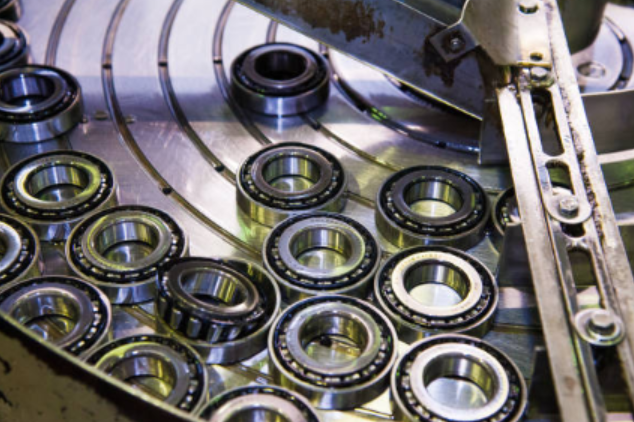
FHV7-AI can detect shiny and black surface bearings.
By adopting Omron’s FHV7-AI Smart Camera, the motorcycle manufacturer transitioned from manual, reactive inspection to a proactive, AI-driven quality control strategy. The solution enhanced product safety, ensured consistent assembly quality, and supported scalable automation for future vehicle models.
This success case demonstrates how AI-powered vision can be practically and effectively applied in automotive assembly lines—solving complex inspection challenges while reducing engineering effort and operational risk
