
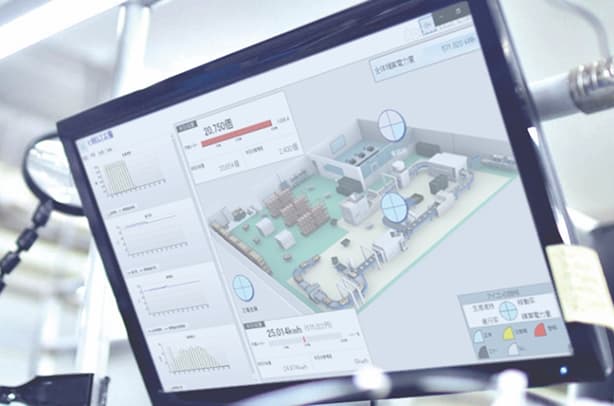
Provided by: ITmedia Inc.
Media published by: MONOist This article is a reprint from MONOist as of March 23, 2020, 10:00 AM.
As labor shortages become more severe, there is significant attention on data utilization using digital technologies in manufacturing sites. However, even when trying to advance data-driven initiatives, the reality is that many manufacturers do not know what to do or how. In this context, Alvac, a vacuum equipment manufacturer, is effectively utilizing “co-creation” to produce various results. Introducing the company’s initiatives.
Utilizing Manufacturing Site Data Created Through "Co-Creation"
As labor shortages become more severe, various challenges are emerging in manufacturing sites that cannot be addressed simply by traditional improvements. Among these, digital technologies such as IoT (Internet of Things) and AI (artificial intelligence) are attracting significant attention on smart factories centered on “data.”
However, despite high interest, many manufacturers often feel confused because they do not know exactly where to start or how to proceed. Amidst this, Albac is an equipment manufacturer centered on vacuum technology, working on utilizing data from manufacturing sites and producing various results.
Although Albac said, “Visualization was never fully implemented to begin with,” it decided to actively pursue “data utilization” as one solution to challenges such as labor shortages, aging population, and environmental measures. As a result, various achievements have been achieved, such as reducing power usage in factory equipment by 23%. One key point of the company’s “data utilization” initiatives is “co-creation.” Why is Alback able to achieve results through various productivity improvements using data? Exploring the secret.
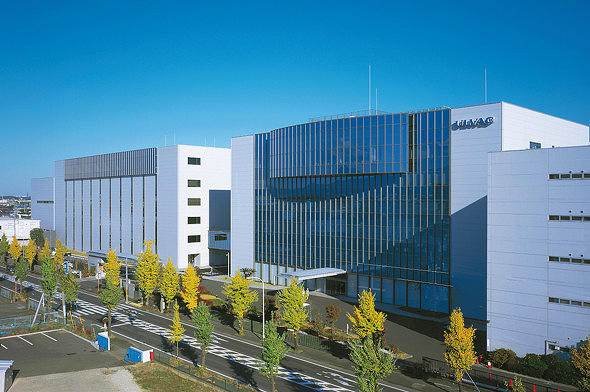
Exterior of Albach’s headquarters factory Source: Albac
Solving the Problem of Skill Transfer for Skilled Technicians with Digital Technology

Mr. Komei Ohno,
Head of Control Development at Alvac Manufacturing Center
Albac is a comprehensive equipment manufacturer founded in 1952, with vacuum technology as its core technology. While the company mainly focuses on vacuum-related equipment, its main businesses are semiconductor manufacturing and display manufacturing, offering equipment such as sputtering equipment, CVD (Chemical Vapor Deposition) equipment, vacuum deposition equipment, and etching equipment.
While these product lines have continued to grow globally, Albac positions the “current major challenge” as the aging of skilled technicians and the resulting skill transfer issues.
Kimiaki Ohno, Head of Control Development at Albac Manufacturing Center, said, “Aging is a major issue. Until now, experienced technicians have used their expertise to prevent failures and fix malfunctions, ensuring quality and delivery times. However, it is clear that these skilled technicians are approaching retirement and will gradually decrease. Furthermore, these experiences have become tacit knowledge, making it difficult to pass on skills, and making judgments about how to proceed within that context. “These personnel issues are already beginning to emerge in various parts of the company,” he says.
However, lacking know-how in data utilization, it was difficult for a single company to implement these specific initiatives on its own. Therefore, Omron was chosen as a “co-creation” partner to create value together.
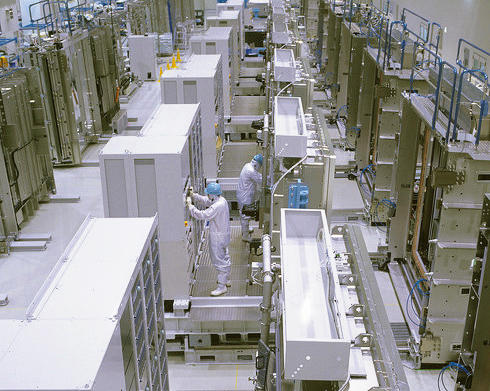
Inside Albac’s headquarters factory Source: Albac
Omron envisions "i-Automation!" Value
Omron is actively engaged in IoT utilization and manufacturing innovation closely tied to manufacturing sites, as part of its “IoT for altitudes below 10 meters.” The concept Omron is promoting as a new value it brings to manufacturing sites is “i-Automation!” That’s right. 「i-Automation!」 The ‘i’ in the name stands for ‘innovative.’ Furthermore, it represents three acronyms: “integrated,” “intelligent,” and “interactive,” and is based on Omron’s existing control equipment of over 200,000 items, combined with 170 types of control program packages through software. A distinctive feature is its commitment to creating new value by utilizing digital technologies such as IoT and AI.
Regarding the reason for choosing Omron as a partner, Mr. Ohno said, “We have had a relationship as a control equipment supplier for about 30 years, and resonating with Omron’s concept amid various challenges became the initial trigger. We identified specific issues within that process and narrowed down the themes to five to advance as a project.”
One of the initiatives is improving power efficiency at our own factories. Various devices are used at the Albac headquarters factory, but monitoring beyond the control of the equipment itself is conducted with only minimal equipment. “Even when trying to utilize data, there was not enough data, and we didn’t know where to start optimizing electricity usage,” said Mr. Ohno.
In response, Omron’s manufacturing site data utilization service “i-BELT” was utilized in concrete initiatives.
Promoting "Co-Creation" through the On-Site Data Utilization Service "i-BELT"
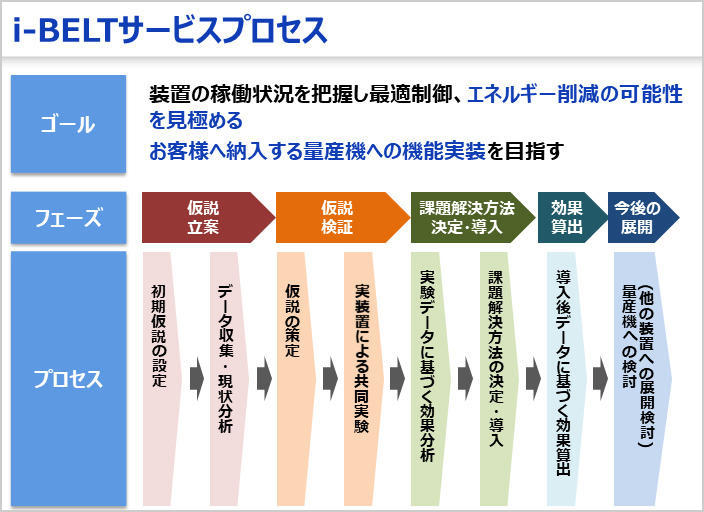
“i-BELT” stands for “i-Automation!” It is a co-creation service that delivers the value it appeals to. Rather than simply analyzing “data,” the key point is Omron’s continuity in advancing on-site reform together with customers by combining engineers familiar with the field, in-house know-how, and expertise in control equipment and software. With a focus on “co-creation,” we repeatedly “collect and accumulate data from the field,” “visualize and analyze data,” and “provide feedback to controls” as if the belt is turning, advancing the evolution of customer sites as partners.
In manufacturing sites, there are many cases where people lack experience or personnel for IoT introduction and utilization, and they often struggle to know where to start. However, because it is a “co-creation service,” it is characterized by the ability to support areas from consulting to operations until actual results are achieved.
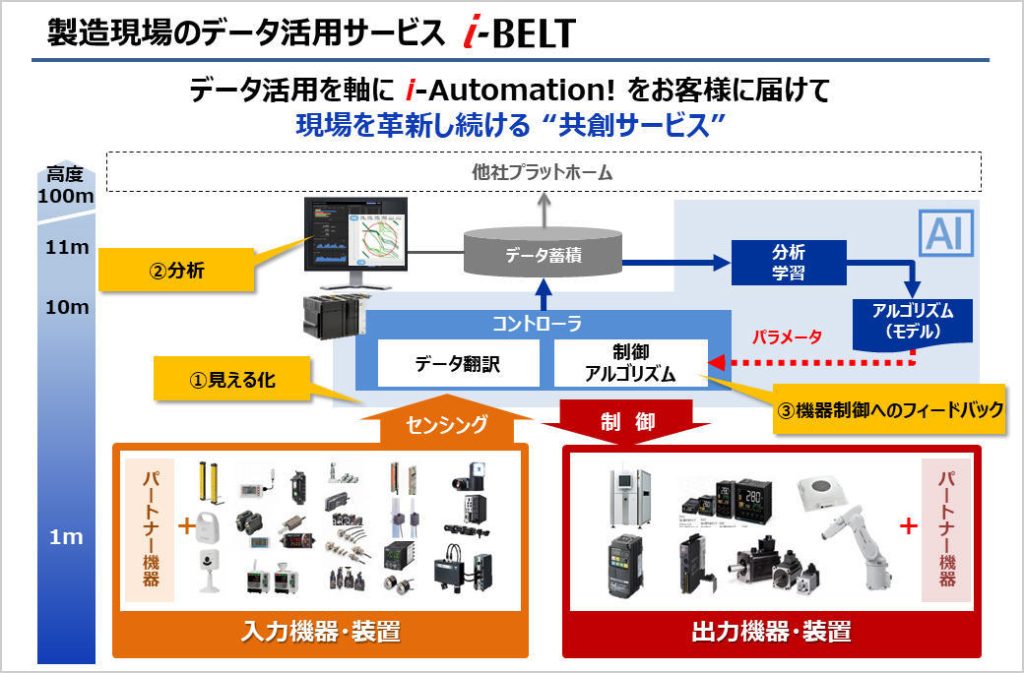
How the data utilization service for manufacturing sites “i-BELT” works. Source: Omron
By utilizing “i-BELT,” Alback collaborated with Omron to advance all aspects of “which data to utilize,” “how to analyze it,” and “how to specifically achieve energy savings.” Specifically, they collected power data used by various facilities and provided it to Omron, then combined this data with operational information to advance analysis.

Akio Umezawa,
System Technology Office , Control Development Department, Alvac Manufacturing Center
Mr. Akio Umezawa of the System Technology Office, Control Development Department, Alback Manufacturing Center, said, “Even in our previous in-house systems, we could measure and view the power of each device on the distribution board. However, that alone only shows the flow of power and does not enable energy savings. “By aggregating and analyzing equipment behavior data, we believed it would be possible to identify points where we could reduce power consumption while minimizing impact on productivity,” he said.
To identify points where actual results could be achieved, we worked with Omron to install sensors on various devices, collected data, and proceeded with analysis. They measured and analyzed the power of various equipment such as heaters, robots, and sputterer power supplies, but ultimately decided to promote energy-saving in vacuum pumps to maintain vacuum levels. Mr. Umezawa stated, “Until now, vacuum pumps have been running 24 hours a day, 365 days a year. However, we thought there might be a timing when it was okay to stop them.”
As a result of further analysis, they succeeded in identifying periods when stopping the vacuum pump did not affect productivity. Therefore, by equipping the vacuum pump with a mode called “Eco Mode” that stops the pump, they succeeded in reducing total equipment electricity consumption by 23% and exhaust system electricity consumption by 66% during the period from March to October. Mr. Umezawa describes the results, saying, “This will save about 2.5 million yen per pump in annual electricity costs.”
By stopping machines during times when stopping operations does not affect productivity, power consumption was successfully reduced.
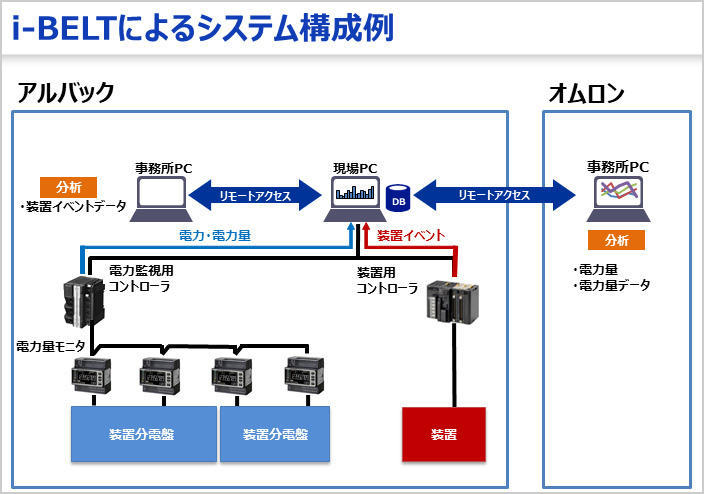
System Configuration for Energy Visualization
Regarding the key points where these values were created, Mr. Ohno emphasizes the results of co-creation with Omron through “i-BELT.”
“In IoT, the focus tends to be mostly on data utilization, and even with many vendor proposals, there is little support for the sensing domain. However, the most challenging part when actually working on it is the sensing domain, which collects data. This time, by co-creating with Omron, which has expertise in sensing, we received a lot of support such as separating desired data from unwanted data. I believe that was a big factor.”
With the results achieved with vacuum pumps, we will further work on energy-saving measures for other facilities and devices, expanding the framework for co-creation through “i-BELT.” “By combining operational data, we can achieve further energy savings even with current equipment. By deploying it to other devices, we hope to help reduce overall power consumption in the factory. “As the next phase, we plan to work on reducing heater power consumption,” Mr. Umezawa said, indicating his commitment to further energy conservation. Furthermore, the company has indicated a policy to further expand efforts to improve productivity through data utilization, rather than relying solely on the know-how of skilled technicians, not just on energy conservation.
Sharing the results of internal data utilization with customers
This initiative involves utilizing data within Albac, but in the future, the framework will be further expanded to further utilize data to enhance the value Albac provides to customers.
Mr. Ohno: “As equipment manufacturers, we are very familiar with the equipment. On the other hand, collecting data is a specialty of Omron, which has advanced sensing technology. This time, by leveraging each other’s strengths, we were able to create value on site. By directing such collaborations toward our customers, we believe we can also help solve their challenges,” expressing enthusiasm for building an ecosystem that includes client companies.
Specifically, it envisions conditions such as Condition-Based Maintenance (CBM) to prevent sudden equipment failures and autonomous improvement support based on data. “It’s important to ensure users can use it with peace of mind. To do that, it’s not just about collecting data—it’s important to analyze it and connect it to the service,” says Mr. Ohno. Even further ahead, by analyzing the quality status of customers’ products and which sensor data is related to which parts of the equipment, it will be possible to uncover the correlation between equipment and quality. Currently, quality improvement is driven by the perspective of skilled on-site technicians, but as sensing and analytical technologies continue to advance, production will become a world centered on data. “I believe we must lead that kind of world,” Mr. Ohno said about his future prospects.
However, the more we try to envision a world that combines the value of equipment with the value of data utilization, the more important it becomes to have partners. For many manufacturers, achieving results through “data utilization” remains challenging. Even when considering actual use of on-site data, many struggle with “which equipment data to obtain at what granularity.” Furthermore, to analyze the data obtained from these methods and feed back the results to the field to improve the site, it is necessary to link with control equipment and install the equipment. Achieving these entire cycles in-house is a high hurdle.
Omron’s “i-BELT” covers the entire cycle and supports you until results are achieved through “co-creation.” Compared to repeatedly experimenting on your own, the advantage is that you can significantly shorten the time until you see results. In that sense, for companies looking to take the step toward “utilizing data in manufacturing sites,” Omron’s “i-BELT” will likely become a strong “leader.”