
Industrial Automation
Connecting Management Decisions with On-Site Improvements Data Solutions 
We connect field data with IT systems, enabling a situation where management and operations can communicate using the same data. Though collaborative problem-solving with our clients, we transform the speed of decision-making into competitive advantage.

Features of i-BELT
Case Studies
Introduction Steps
Even when systems are introduced to promote DX, operations continue to rely on experience and intuition, and tasks remain dependent on specific individuals. Furthermore, the lack of standardized formats for equipment and production data often leads to manual processing and aggregation, resulting in increased man-hours and input errors. Many manufacturing sites also share challenges such as being unable to acquire data due to aging equipment, or being unable to fully utilize the data even if it is acquired.
So why isn’t the implementation of smart factories progressing as smoothly as expected on the factory floor? The answer lies in the disconnect between “IT (management)” and “OT (operational technology).” This disconnect prevents the full potential of data from being realized, making digital transformation (DX) difficult. To bridge this gap and utilize data as a true asset, “IT-OT integration” is crucial. This article will clearly explain why this disconnect occurs between IT and OT, and how IT-OT integration can solve the challenges facing the manufacturing industry.
IT and OT have developed with entirely different purposes and backgrounds. To understand the integration of IT and OT, it is essential to first correctly grasp the purposes and backgrounds of IT and OT. Furthermore, the reasons why organization barriers often exist between IT and OT teams become clear when you look at the fundamental differences in their respective roles.
The primary role of IT (Information Technology) is the “management and utilization of information assets.” Representative systems include ERP (Enterprise Resource Planning), which centrally manages a company’s resources, and SCM (Supply Chain Management), which optimizes the supply chain. IT aims to improve operational efficiency and support decision-making.
The primary role of OT (operational technology) is the control and operation of physical equipment. In manufacturing environments, systems such as PLCs (programmable logic controllers) and SCADA (supervisory control and data acquisition systems) are used to control machinery and robots. OT places particular emphasis on stable equipment operation and requires high levels of real-time performance, safety, and reliable execution of predefined actions.
IT and OT differ significantly in terms of objectives, management targets, and priorities. The characteristics of each are summarized below.
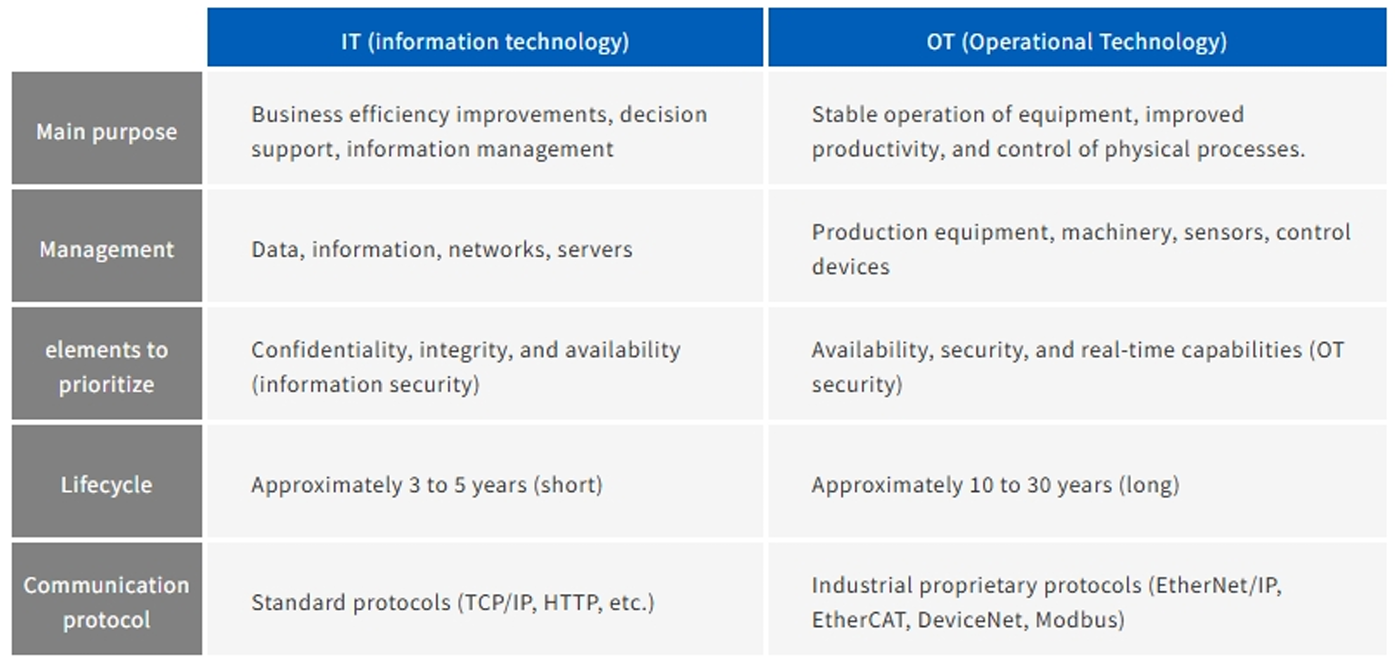
As IT focuses on data utilization and business optimization, systems are typically updated every few years, with active adoption of open communication technologies and new innovations. OT, on the other hand, prioritizes stable operation of production equipment, resulting in less frequent system updates and the continued use of industry-specific communication protocols and specialized technologies. These differences in technical assumptions and priorities are one of the factors underlying the divide between IT and OT departments.
Limited visibility into real-time operations for management decision-making
In the executive layer (IT) level, siloed systems and data across departments delay visibility into business conditions and investment decisions. Manual KPI and P&L aggregation requires significant time and effort, making it difficult to respond quickly to rising operating costs and supply chain issues. As a result, investment decisions are often delayed.
In addition, because core systems operate on global standards and cannot easily be modified, it is difficult to obtain visibility into equipment operating conditions and quality information, making it challenging to quantitatively assess business impact and return on investment.
Delayed decision-making and missed opportunities caused by non-standardized data and operating standards
In the management (edge) layer, differences in data and operating standards between IT and OT require significant effort for information organization and utilization. In addition, differences in equipment usage and data aggregation methods between sites make it difficult to compare compare production performance across multiple factories, often resulting in lengthy analysis processes that must be completed before enterprise-wide optimization can be achieved.
Limitations on data acquisition and utilization caused by aging equipment
In the on-site (OT) layer, legacy systems and aging equipment that have been in operation for many years present major obstacles. As equipment has undergone specific optimization over time, factories often contain a mix of old and new equipment from different manufacturers.
As a result, communication standards and data formats differ from one machine to another, making data centralization difficult. Even when data can be collected from newer production lines, inconsistencies in data formats across the factory prevent effective analysis and utilization for overall optimization
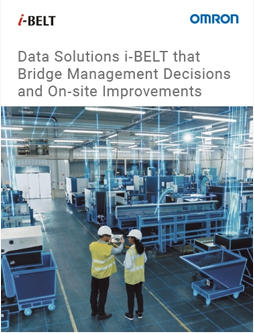
i-BELT Data Solutions that Bridge Management Decisions and On-Site Improvements
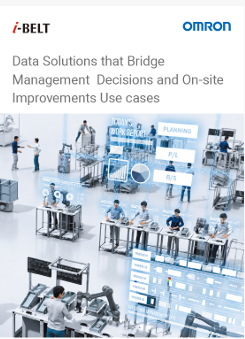
Use Cases: Bridging Management Decisions with Shop Floor Improvements
Have Questions About OMRON i-BELT?
| Cookie | Duration | Description |
|---|---|---|
| cookielawinfo-checbox-analytics | 11 months | This cookie is set by GDPR Cookie Consent plugin. The cookie is used to store the user consent for the cookies in the category "Analytics". |
| cookielawinfo-checbox-functional | 11 months | The cookie is set by GDPR cookie consent to record the user consent for the cookies in the category "Functional". |
| cookielawinfo-checbox-others | 11 months | This cookie is set by GDPR Cookie Consent plugin. The cookie is used to store the user consent for the cookies in the category "Other. |
| cookielawinfo-checkbox-necessary | 11 months | This cookie is set by GDPR Cookie Consent plugin. The cookies is used to store the user consent for the cookies in the category "Necessary". |
| cookielawinfo-checkbox-performance | 11 months | This cookie is set by GDPR Cookie Consent plugin. The cookie is used to store the user consent for the cookies in the category "Performance". |
| viewed_cookie_policy | 11 months | The cookie is set by the GDPR Cookie Consent plugin and is used to store whether or not user has consented to the use of cookies. It does not store any personal data. |